
Understanding Brazil’s Criminal Background Check Requirements for Digital Nomads
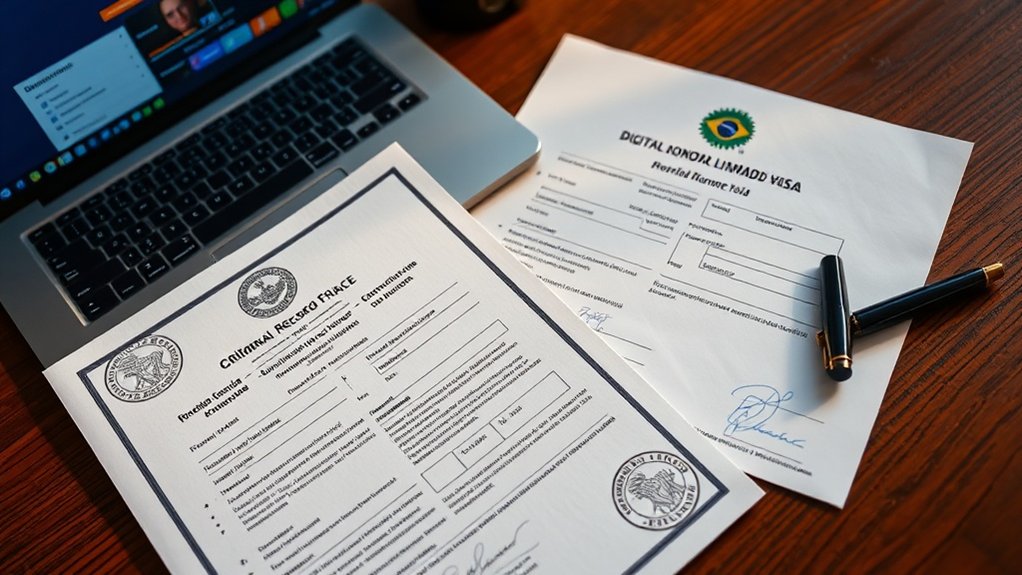
Essential Authentication Steps: Apostilles and Consular Validations
You’ll need to authenticate your criminal record certificate through either an apostille or consular validation before Brazil accepts it. The apostille process applies if your country participates in the Hague Convention, while consular validation becomes necessary for non-Hague Convention countries. Each authentication method involves specific steps and requirements that you must complete to ensure your document meets Brazil’s legal standards. Professional guidance is essential to avoid these issues and ensure legal compliance throughout the authentication process.Apostille Process Requirements
Once your criminal background check is complete, you must authenticate it through an apostille process to meet Brazil’s international document standards. You’ll need to submit your certificate to the designated authority in your country—typically the Secretary of State’s office or foreign ministry. This process verifies the document’s authenticity for international use.| Document Type | Processing Authority | Typical Timeline |
|---|---|---|
| FBI Background Check | U.S. Department of State | 3-5 business days |
| State Criminal Record | Secretary of State Office | 1-3 business days |
| Foreign Certificate | National Competent Authority | 5-10 business days |
Consular Validation Steps
After obtaining your apostilled criminal record certificate, Brazilian consulates require additional validation to confirm the document meets their specific standards. You’ll need to schedule an appointment at the Brazilian consulate in your jurisdiction to submit your apostilled documents for consular validation.During your appointment, consular officers will verify the apostille’s authenticity and ensure your criminal record certificate complies with Brazilian legal requirements. They’ll examine the document’s format, issuing authority, and official seals. You must bring original documents along with certified copies.The consular validation process typically takes 5-10 business days, though processing times vary by location. Some consulates offer expedited services for additional fees. Once validated, your criminal record certificate becomes legally recognized for your digital nomad visa application in Brazil. Simple mistakes during this validation process can result in application denials or unnecessary delays, affecting your personal and professional plans for establishing digital nomad status in Brazil.Certified Translation Standards That Meet Brazilian Legal Requirements

Common Documentation Mistakes That Delay Visa Processing
You’ll face significant delays if you submit incomplete criminal record documents that don’t cover all required jurisdictions or time periods. Poor translation quality that doesn’t meet Brazil’s certified standards will result in automatic rejection of your application. Missing apostille certification on your documents means they won’t be legally recognized by Brazilian authorities, forcing you to restart the entire process. Working with an experienced immigration lawyer ensures your documentation meets all Brazilian requirements and minimizes the risk of costly delays or rejections.Incomplete Criminal Record Documents
One of the most frequent reasons for Brazil’s digital nomad visa delays stems from submitting incomplete criminal record certificates. You’ll face rejection if your documents don’t cover all required jurisdictions where you’ve lived for six months or longer during the past five years. Many applicants forget to include records from states or countries where they’ve resided temporarily, thinking only their primary residence matters.Your criminal record certificate must be recent, typically issued within 90 days of your visa application. Don’t submit expired documents or assume older certificates will suffice. Each jurisdiction requires separate documentation, and you can’t substitute one location’s records for another’s. Missing even one required certificate forces consular officers to request additional documentation, extending your processing timeline significantly and potentially jeopardizing your application approval. Professional assistance from an experienced immigration lawyer can help you avoid these common errors that frequently delay visa requests.Poor Translation Quality
When submitting criminal record certificates for Brazil’s digital nomad visa, poor translation quality frequently derails applications that would otherwise receive approval. You’ll encounter rejections when your translations contain inaccuracies, missing official stamps, or formatting errors that immigration officers can’t overlook.Common translation problems that cause delays include:- Literal word-for-word translations that don’t convey proper legal terminology in Portuguese
- Missing sworn translator credentials or improper certification stamps from unqualified translators
- Inconsistent formatting that doesn’t match Brazilian consular requirements for official document presentation
Missing Apostille Certification
Although your criminal record certificate might be perfectly translated, missing apostille certification will trigger an immediate rejection from Brazilian immigration authorities. The apostille authenticates your document’s legitimacy through an internationally recognized seal that confirms the signature, capacity, and seal of the official who signed your criminal record certificate.You can’t obtain an apostille after translating your document. The certification must happen before translation begins. Contact your country’s designated apostille authority—typically the Secretary of State’s office in the US—to process your criminal record certificate. This step validates your document’s authenticity for international use.Without proper apostille certification, your digital nomad visa application will face delays or outright rejection, regardless of translation quality. Such documentation errors are among the most common mistakes that can jeopardize your immigration status and require experienced legal support to prevent costly bureaucratic complications.Critical Deadlines and Timing Considerations for Application Success
Timing your criminal-record certificate application correctly can make or break your Brazil digital nomad visa success. You’ll need to account for multiple processing stages that can extend your timeline significantly.Here’s what you must consider for proper timing:- Certificate issuance: Most countries require 2-4 weeks for criminal-record certificates, though some jurisdictions take up to 8 weeks during peak periods.
- Apostille processing: Add another 1-3 weeks for apostille certification, depending on your state or country’s processing capacity and current workload.
- Translation completion: Professional translation services typically need 3-5 business days, but complex documents or high-demand periods may extend this timeframe.
How Vieira Braga Streamlines the Criminal Record Certificate Process
Frequently Asked Questions
What do you need for a digital nomad visa in Brazil?
Applicants must show proof of income from abroad, health insurance, criminal-record certificates (with sworn translation), and a valid passport.
How do you qualify for a digital nomad visa in Portugal?
You need proof of remote income meeting the minimum threshold, a work contract or service agreement, and accommodation evidence.
Is it hard to get a Spanish digital nomad visa?
It’s attainable with proof of foreign income, professional qualifications, and health insurance, though documentation must be thorough.
What is Italy’s new digital nomad visa?
Italy allows skilled remote workers from outside the EU to reside legally if they meet income and tax compliance requirements.
How hard is it to get a digital nomad visa?
Difficulty varies by country; strong documentation, income proof, and compliance with consular requirements are essential.
How long can you stay in Brazil with a digital nomad visa?
Up to one year, renewable for an additional year if conditions remain met.
Can I Use a Criminal Record Certificate From a Previous Visa Application?
You can’t reuse a criminal record certificate from a previous visa application for Brazil’s digital nomad visa. Brazilian authorities require fresh documentation that’s typically no older than 90 days from the issuance date. Even if your previous certificate seems recent, immigration officials need current verification of your criminal history status. You’ll need to obtain a new certificate and ensure it’s properly translated and apostilled for your application.What Happens if I Have a Criminal Record in Multiple Countries?
You’ll need to obtain criminal record certificates from every country where you’ve lived or had legal issues. Brazil’s digital nomad visa application requires comprehensive documentation of your criminal history across all jurisdictions. Each certificate must be properly apostilled and translated into Portuguese by a certified translator. Don’t omit any countries – incomplete documentation will result in visa denial and delays in your application process.Are Juvenile Criminal Records Included in the Background Check Requirements?
Juvenile criminal records aren’t typically included in Brazil’s digital nomad visa background check requirements. You’ll generally only need to provide criminal record certificates covering your adult years, usually from age 18 onward. However, requirements can vary by country and specific circumstances. If you’re unsure about your situation, you should consult with Brazilian immigration authorities or a qualified attorney to confirm what documentation you’ll need for your application.How Much Does the Complete Criminal Record Certificate Process Typically Cost?
You’ll typically spend $200-600 for the complete criminal record certificate process. This includes FBI background checks ($18), state-level certificates ($10-50 each), apostille services ($20-50 per document), and sworn Portuguese translations ($30-80 per page). Costs vary depending on how many states you’ve lived in, translation complexity, and whether you use expedited services. Additional fees may apply for notarization and document courier services.Can I Start the Visa Application Before Receiving My Translated Documents?
You shouldn’t start your Brazil Digital Nomad Visa application before receiving your translated criminal record certificates. Brazilian immigration authorities require complete documentation packages, and submitting incomplete applications often leads to delays or rejections. You’ll need properly translated and apostilled criminal records from every country where you’ve lived. It’s better to wait until you’ve received all translated documents to ensure your application moves smoothly through the approval process.Conclusion
You can’t afford to let documentation errors derail your Brazil digital nomad visa dreams. With Vieira Braga’s specialized expertise, you’ll navigate criminal record requirements, apostille certifications, and sworn translations seamlessly. They’ll ensure your documents meet Brazil’s stringent standards while preserving critical formatting and legal terminology. Don’t risk delays or rejections—trust Vieira Braga’s proven process to secure your criminal record certificates and translations correctly the first time.